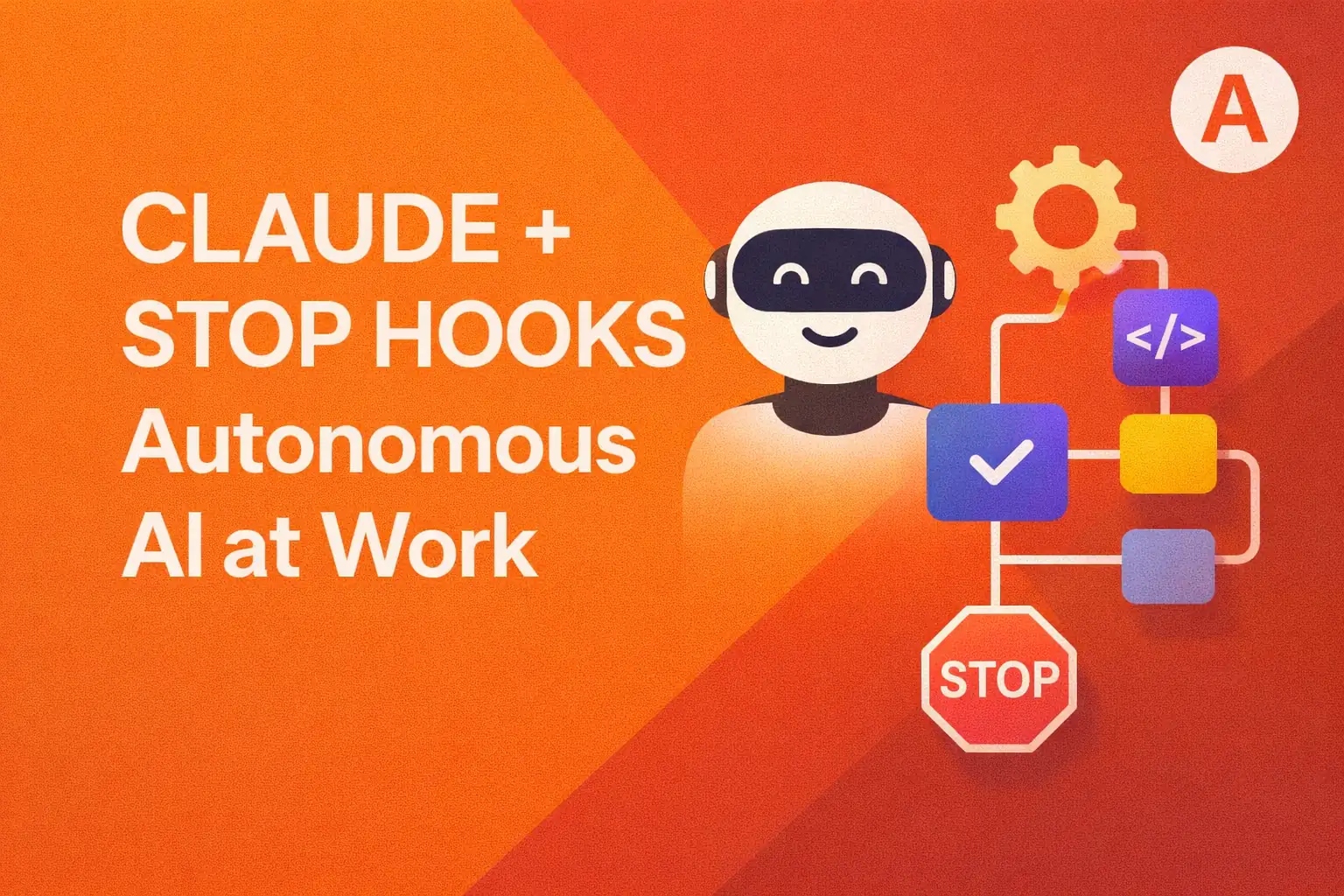
Claude Opus 4.5 and Stop Hooks: How Autonomous AI Is Redefining Productivity
- From assistant to autonomous executor
- What stop hooks actually are
- Why structure matters more than raw intelligence
- Real-world examples of long-running AI work
- What this changes for teams and productivity
- The risks and why limits still matter
- Where autonomous AI is heading next
From assistant to autonomous executor
Most AI tools today still depend heavily on human supervision. You give a prompt, review the output, adjust, and repeat. Claude Opus 4.5 introduces a different dynamic.
With the right setup, the model can continue working on a task long after the initial instruction. It plans, executes, evaluates results, and decides what to do next. Human input becomes occasional guidance rather than constant control.
This is not about faster answers. It is about sustained execution.
What stop hooks actually are
Stop hooks are deliberate checkpoints built into an AI workflow. Instead of letting a model run endlessly, the system defines clear moments where the AI must pause, evaluate progress, or ask for confirmation.
Think of them as guardrails. The AI is allowed to move forward on its own, but only within well-defined boundaries.
In Claude Opus 4.5, these hooks make it possible to run long sessions without losing control. They prevent infinite loops, runaway tasks, or unnecessary work while still allowing deep autonomy.
Why structure matters more than raw intelligence
Autonomous AI does not work well without structure. The most impressive results come from combining Claude Opus 4.5 with clear task decomposition.
One example is using a structured workflow system or plugin that forces tasks into small, executable steps. Each step has a goal, an expected output, and a condition for moving forward.
This turns the AI into something closer to a project executor than a chatbot.
Real-world examples of long-running AI work
Autonomous code development. In one documented setup, Claude Opus 4.5 worked through a backlog of engineering tasks over several weeks. It generated features, refactored code, opened pull requests, reviewed its own output, and iterated. The result was hundreds of pull requests and tens of thousands of lines of code without daily human micromanagement.
Large-scale refactoring. Instead of asking an AI to refactor one file at a time, teams can define a refactoring strategy and let the model apply it across an entire codebase, stopping only when validation checks fail.
Research and synthesis. Claude can be tasked with exploring a complex domain, reading documentation, comparing approaches, and producing structured reports over several hours. Humans step in only to redirect or approve conclusions.
Internal tooling. Teams can assign the AI to improve internal scripts, clean up automation pipelines, or optimize workflows, while humans focus on higher-level decisions.
What this changes for teams and productivity
This shift changes how we measure productivity. Instead of counting prompts or responses, teams start thinking in terms of outcomes delivered per AI session.
Human effort moves upstream. People define goals, constraints, and success criteria. The AI handles execution.
This also changes collaboration. AI becomes a semi-independent contributor that hands work back to humans when it genuinely needs input.
The risks and why limits still matter
Autonomy comes with risk. An AI that runs too freely can waste resources, drift off-goal, or produce work that looks correct but is subtly flawed.
This is why stop hooks, time limits, and evaluation steps are critical. Autonomous does not mean uncontrolled.
Teams that treat AI like a junior engineer, with clear expectations and review points, see far better results than those who simply let it run.
Where autonomous AI is heading next
Claude Opus 4.5 offers a glimpse of a future where AI systems are not just reactive tools, but active participants in execution.
As workflows become more structured and safeguards more robust, autonomous AI will likely become standard for long-running tasks such as development, research, and system optimization.
The key question is no longer whether AI can do the work, but how we design systems that let it work safely, effectively, and productively alongside humans.
Autonomous AI is not replacing teams. It is reshaping what teams spend their time on.