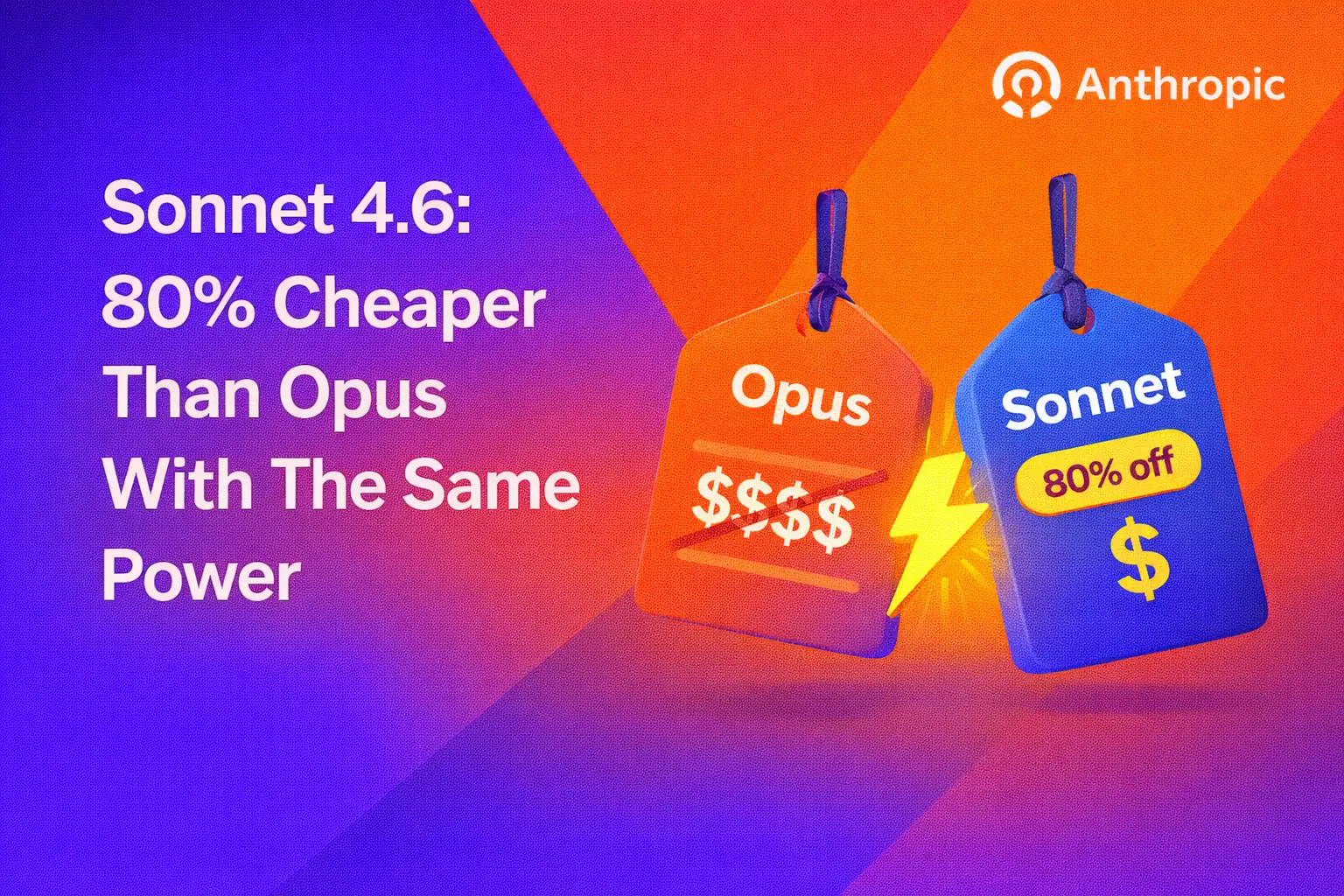
Claude Sonnet 4.6 for OpenClaw: Should You Replace Opus?
- What changed in Sonnet 4.6
- Why this matters for teams and workflows
- Agent performance vs Opus: what “similar” means in practice
- The real win: cost changes behavior
- Why Sonnet 4.6 should be the default in OpenClaw
- Practical use cases you can run today
- A simple model strategy: when to still use Opus
- Guardrails to avoid waste and runaway automation
What changed in Sonnet 4.6
Sonnet 4.6 is positioned as a fast, scalable model for agentic work.
The big headline is not “it beats Opus at everything”.
The big headline is: it’s close enough on most tool-heavy workflows that it becomes the rational default — especially when you pay per token or you run long sessions.
What users tend to notice immediately:
- Faster responses in multi-step tasks
- Lower costs for long-running agent workflows
- Less hesitation to run automation overnight or continuously
Why this matters for teams and workflows
Teams rarely use AI for a single one-shot answer.
They use it for workflows:
- Monitoring and summarizing signals
- Drafting and iterating content and docs
- Tool orchestration across systems
- Research loops
- Automation jobs that run daily or hourly
These workflows become expensive fast if the model is too costly.
Sonnet 4.6 shifts that. It makes “always-on agent behavior” much more realistic for normal budgets.
Agent performance vs Opus: what “similar” means in practice
When people say Sonnet 4.6 is “similar” to Opus for agentic work, they usually mean it performs well on the boring-but-important parts:
- It follows tool instructions reliably
- It can plan multi-step tasks without constant babysitting
- It keeps context across a workflow without losing the thread
- It stays stable when it needs to iterate and retry
That is exactly what matters in OpenClaw-style setups.
In practice, “agentic quality” is less about perfect prose and more about making the right next step, using the right tool, avoiding infinite loops, and returning a structured result you can act on.
The real win: cost changes behavior
This is the part that actually changes your output.
When your model is expensive, you avoid running the high-value workflows because they “feel too expensive”.
Examples of workflows teams often avoid with expensive models:
- Running a nightly competitor scan across multiple channels
- Doing daily analytics collection when no API exists (manual browser work)
- Letting an agent iterate on an internal tool for hours to clean up edge cases
- Long document processing (contracts, policies, technical specs) with structured summaries
With a cheaper model, these workflows become normal. And once they become normal, your output compounds.
Why Sonnet 4.6 should be the default in OpenClaw
OpenClaw is an orchestration environment.
Its strength is not “one clever answer”. Its strength is delegation, parallel tasks, tool usage and automation routines.
If Sonnet 4.6 delivers near-Opus agentic performance at a fraction of the cost, it becomes the practical default model.
A simple rule of thumb:
- Use Sonnet 4.6 for the day-to-day operational agent work
- Keep Opus as an escalation option for the rare “high-risk, high-complexity” tasks
Practical use cases you can run today
Use case 1: Trend monitoring that turns into real actions
Instead of “summarize what’s trending”, run it like an operational workflow:
- Scan X and Reddit for a specific niche (example: AI agents for marketing ops)
- Extract recurring pain points and repeated questions
- Propose 3 automation ideas your team could implement
- Create a short task plan for the best one
Business value:
- You get market research that turns into backlog items
- You reduce guesswork when deciding what to build next
- You can run it nightly without worrying about runaway cost
Use case 2: Overnight “maintenance agent” for a repository
This is not “AI writes your entire product”. It’s a realistic maintenance workflow:
- Check dependencies that are outdated
- Open a PR for safe version bumps
- Update docs where they are obviously out of sync
- Run linting and fix low-risk formatting issues
- Produce a morning report of what changed and what to test
Business value:
- Your repo stays healthier with less manual overhead
- You reduce “maintenance debt” that causes future outages
- Developers spend time on features, not housekeeping
Use case 3: Internal reporting without building dashboards first
Example workflow:
- Pull weekly metrics from existing sources (docs, sheets, exports)
- Generate a structured summary: wins, losses, anomalies, action items
- Post to Slack in a consistent format every Monday morning
Business value:
- Less meeting time spent “figuring out what happened”
- Faster decisions because the story is already summarized
- Better accountability because action items are explicit
A simple model strategy: when to still use Opus
Sonnet 4.6 can be your default, but there are still moments where Opus is worth it:
- Complex architectural decisions that require deep reasoning
- High-risk refactors across many modules
- One-shot implementation where you want maximum quality in a single pass
- Cases where mistakes are expensive (production systems, sensitive data flows)
In practice: Sonnet for 80–90% of operational tasks, Opus as the “senior consultant” when it truly matters.
Guardrails to avoid waste and runaway automation
Cheaper models increase usage — which is good — but it also makes it easier to accidentally run wasteful workflows.
Basic guardrails that help:
- Hard limits: maximum steps per task
- Budget caps per day per workflow
- Approval gates for destructive actions (delete, overwrite, revoke)
- Logging: store every tool call and every external action
- Scheduling discipline: not everything should run hourly
The goal is simple: make it cheap enough to run often, but controlled enough to trust.
The bottom line:
Sonnet 4.6 is not exciting because it is “the smartest model ever”.
It’s exciting because it makes serious agent workflows affordable enough to become normal.
And once these workflows become normal, teams start working differently.
Curious what AI can build for your business?
I build AI-powered apps, automations and content pipelines - like the Hola Calle language app.
Get in touch