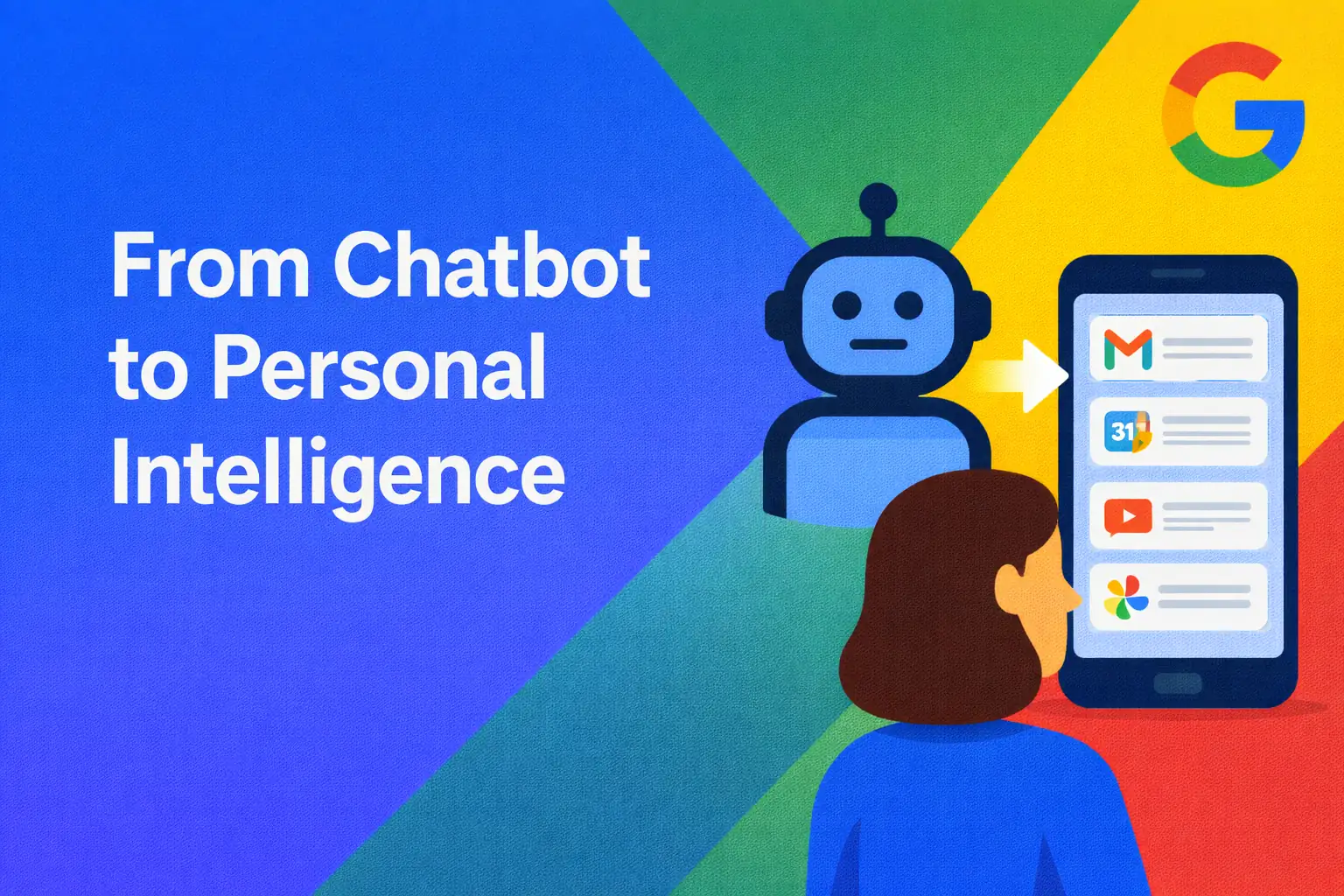
Gemini Personal Intelligence: How Google Is Turning AI Into Your Digital Memory
- What Gemini Personal Intelligence actually is
- How it works in practice
- Concrete everyday examples
- What this changes for work and productivity
- Privacy, control and the real trade-offs
- Availability and rollout status
- Why this matters more than people think
What Gemini Personal Intelligence actually is
Gemini Personal Intelligence is Google’s first serious attempt to let AI reason across your personal digital footprint instead of isolated prompts.
Until now, even advanced AI assistants worked in a vacuum. You had to upload files, paste emails, explain context and remind the system what mattered. Gemini changes that by using signals that already exist: how you communicate, what you save, what you watch, where you go and how you schedule your time.
The result is an assistant that doesn’t just answer questions, but understands patterns: habits, priorities, recurring themes and implicit commitments.
This is where AI stops being reactive and starts feeling anticipatory.
How it works in practice
Once enabled, Gemini can query information across multiple Google services simultaneously. It does not rely on you remembering where something lives.
For example, a single question can trigger:
- a scan of Gmail threads for context
- a lookup in Calendar for scheduling decisions
- a search through Drive documents and PDFs
- pattern recognition in Photos and screenshots
- reference to YouTube videos you already watched
You are no longer managing files. You are managing intent.
Concrete everyday examples
Here’s where this starts to feel different from any AI we’ve used before.
Finding information you didn’t label
You took a photo of a whiteboard during a client meeting three weeks ago. No title, no folder, no notes. Gemini can locate it by understanding that the photo was taken during a calendar event with that client and contains handwritten task lists.
Recovering forgotten decisions
You ask: “Why did I move my call with Anna last month?” Gemini checks the email thread, sees a scheduling conflict with another meeting, and references a note you saved later that week confirming the reason.
Understanding implicit commitments
You ask: “What promises did I make recently that I haven’t followed up on?” Gemini cross-references emails where you said “I’ll send this” or “I’ll look into it”, checks Calendar for reminders that were never created, and highlights gaps.
Visual memory without tagging
You are in a parking garage and ask which car you drive. Gemini recognises repeated photos you took of the same vehicle, correlates them with Maps locations and calendar events, and answers correctly without you ever tagging a photo.
Watching less, understanding more
You ask: “Summarise the YouTube videos I watched about Spanish property taxes and tell me what changed since last year.” Gemini combines your watch history with recent Search results and highlights only what’s new.
What this changes for work and productivity
In a work context, this is where the impact compounds.
Email overload becomes manageable
Instead of scrolling, you ask: “What decisions were made in this thread?” Gemini summarises outcomes, not messages.
Meetings become searchable memory
Gemini can connect calendar events, documents created afterward and follow-up emails to give you a narrative, not just files.
Faster decision-making
When context is already assembled, decisions stop being blocked by retrieval. You spend less time remembering and more time choosing.
This is especially powerful for founders, consultants, creators and knowledge workers whose work is scattered across tools.
Privacy, control and the real trade-offs
This is also where discomfort is justified.
Google states that data used for Gemini Personal Intelligence is not used to train public models and that users retain app-level control. You decide which services are connected and can revoke access at any time.
Still, this marks a psychological shift. AI is no longer just something you consult. It becomes something that remembers alongside you.
The real question is not whether this is safe or unsafe, but whether we are ready for AI to function as an external cognitive layer.
Availability and rollout status
There are important limitations right now.
Gemini Personal Intelligence is available on the web, Android and iOS — but only for personal Google accounts. Despite being deeply useful for professionals, it is currently not available for Google Workspace accounts.
In addition, access requires a Google AI Pro or Ultra subscription and is limited to users in the United States. International rollout is delayed, and availability outside the US remains partially on hold at the time of writing.
This somewhat unusual combination — personal accounts only, but not Workspace — strongly suggests a cautious rollout focused on individual behaviour before enterprise adoption.
Why this matters more than people think
This is not about better answers.
This is about shifting responsibility for memory, retrieval and context from humans to machines.
We are moving from “AI helps me search” to “AI understands what I mean, even when I don’t remember the details myself”.
That will change how we work, how we plan, and how much mental load we carry.
The real advantage will not go to those who work harder, but to those who learn how to collaborate with AI inside their existing workflows.
The question is no longer whether this is coming.
The question is whether you will treat AI as a tool or as a partner in thinking.
Curious what AI can build for your business?
I build AI-powered apps, automations and content pipelines - like the Hola Calle language app.
Get in touch