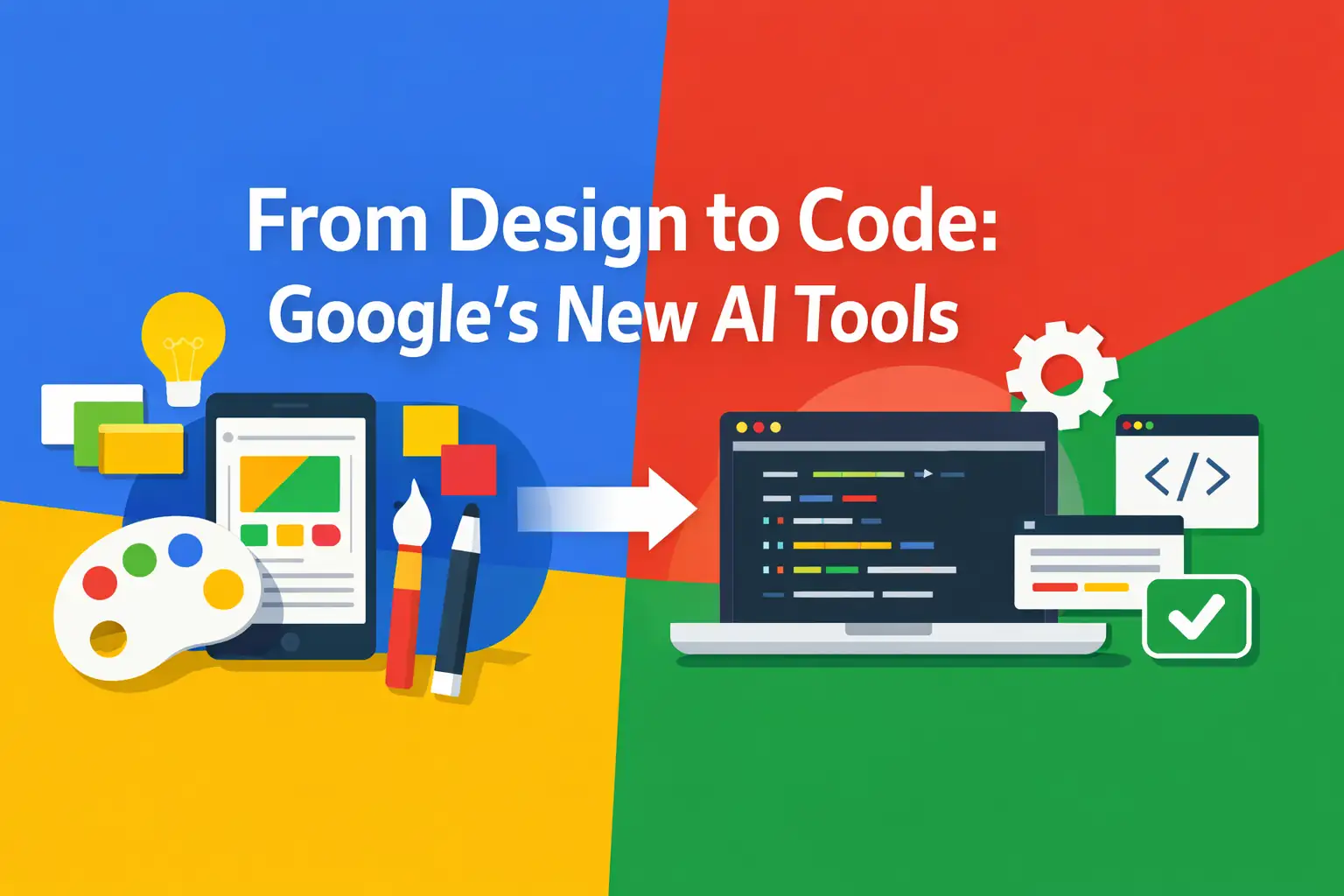
Google Stitch and AI Studio Explained: From Idea to Working App with AI
- What Google just introduced
- Stitch and the shift toward structured design
- Why design in markdown changes the game
- AI Studio as a full stack building environment
- The emerging idea to product loop
- What this means for teams and workflows
- Why this matters for AI agents
- Current limitations and realistic expectations
- The bigger direction Google is moving toward
What Google just introduced
Two tools stood out this week.
The first is Stitch, a design focused tool that allows users to generate and refine interfaces using AI.
The second is an expanded AI Studio experience that moves beyond experimentation and into building real applications.
Individually, both tools are useful. Together, they point toward something more important.
A connected workflow where an idea can move from concept to design to code to working product with fewer manual steps in between.
Stitch and the shift toward structured design
Stitch can generate user interfaces from prompts and allows users to iterate quickly by creating multiple variations, adjusting layouts, and refining visual styles.
At first glance, this may look similar to other AI design tools.
The difference is that Stitch does not focus only on visual output. It introduces a more structured way of defining design.
Users are not just generating screens. They are defining rules, patterns, and decisions that shape how those screens behave.
This turns design into something that can be reused and improved, rather than something that needs to be recreated from scratch each time.
Why design in markdown changes the game
One of the most interesting elements is the use of a design file that behaves like markdown.
This file captures things like layout logic, color systems, and component behavior in a structured format.
This has several practical implications.
First, it makes design more consistent. Rules can be applied across different screens without manual repetition.
Second, it makes design more accessible to AI systems. Structured data is easier for models to interpret than raw visual output.
Third, it creates a reusable layer that can be shared across projects.
Instead of treating each design as a one time artifact, teams can build a design system that evolves over time.
This is where the shift becomes meaningful. Design starts to behave more like code.
AI Studio as a full stack building environment
The second part of the story is the evolution of AI Studio.
Google is turning it into an environment where designs or screenshots can be transformed into working applications.
This goes beyond generating static layouts.
The system can create interactive elements, handle basic logic, and provide a starting point for features such as filtering, navigation, and data handling.
In practice, this means a designer or product thinker can move directly from an interface idea to a functional prototype.
The gap between design and development becomes smaller.
The emerging idea to product loop
When Stitch and AI Studio are combined, a new workflow starts to appear.
A simple version of that workflow looks like this:
- Start with an idea
- Generate and refine an interface
- Convert that interface into working code
- Iterate on the product
This loop already exists in traditional product development, but it is often slow and fragmented.
Different tools, teams, and processes create friction at every step.
What Google is building reduces that friction by connecting these steps more directly.
The result is faster iteration and a shorter path from concept to execution.
What this means for teams and workflows
For teams, the impact is practical rather than theoretical.
Several changes become possible.
Faster prototyping
Ideas can be turned into working prototypes without waiting for full development cycles.
Smoother collaboration
Design and development become more aligned because both are working from structured, shared inputs.
Lower friction
Fewer handoffs between tools and roles reduce delays and misunderstandings.
More experimentation
Teams can test more ideas because the cost of building and iterating is lower.
This does not remove the need for strong product thinking, but it allows teams to move faster once direction is clear.
Why this matters for AI agents
The most interesting part may not be the tools themselves, but how they fit into a broader trend.
AI systems are increasingly moving from assistants to participants in workflows.
For that to work, they need structured environments where they can understand inputs and produce consistent outputs.
Stitch and AI Studio contribute to that structure.
Design defined in a structured format can be interpreted by agents.
Code generated from that design can be modified or extended by those same agents.
This creates the possibility of workflows where agents help not only with individual tasks, but with entire stages of product development.
Current limitations and realistic expectations
Despite the progress, these tools are not complete replacements for experienced designers or developers.
There are still limitations.
- Generated designs may require refinement for usability and quality
- Code output may need adjustments for scalability and performance
- Complex applications still require architectural decisions
The value today is in acceleration, not full automation.
Teams that treat these tools as productivity multipliers rather than replacements will get the most benefit.
The bigger direction Google is moving toward
The most important takeaway is the direction of travel.
Google is building toward an environment where describing a product, refining it, and turning it into something functional becomes a continuous process.
Design becomes structured.
Development becomes more automated.
Workflows become more connected.
This does not happen overnight, but the pieces are starting to come together.
For teams that build products, this means one thing above all.
The distance between idea and execution is getting shorter.
Curious what AI can build for your business?
I build AI-powered apps, automations and content pipelines - like the Hola Calle language app.
Get in touch