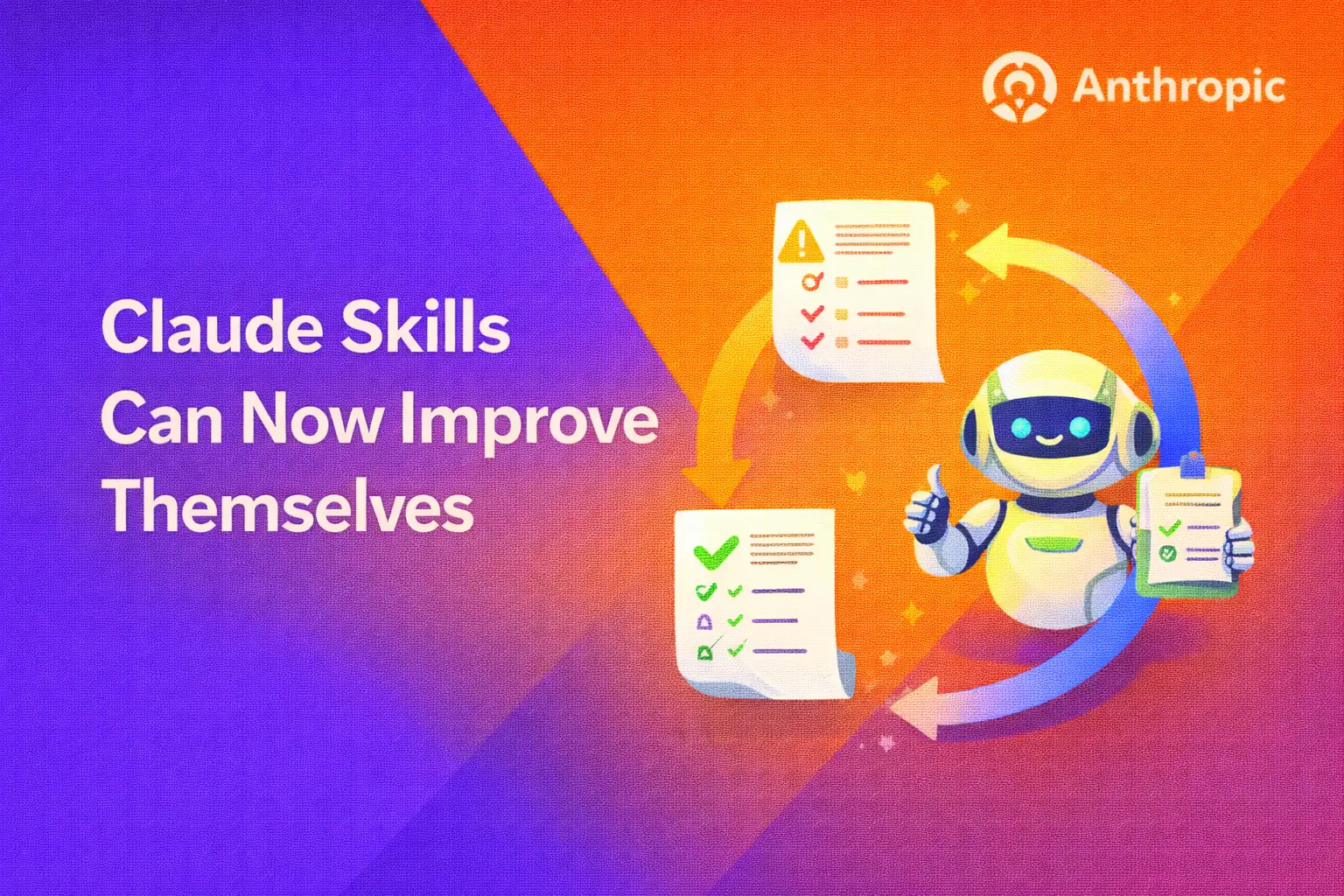
How Auto Research Can Make Claude Code Skills Improve Themselves
- Why Claude Code Skills sometimes struggle
- What Auto Research actually means
- Why Andrej Karpathy’s idea matters here
- How Claude Code Skills can improve themselves
- Why metrics are the key to better skills
- Building a simple evaluation system
- Turning prompt iteration into optimization
- Why this idea matters beyond Claude Code
Why Claude Code Skills sometimes struggle
Claude Code Skills allow developers to package instructions and workflows into reusable tools that the model can execute. They are extremely useful for automating tasks inside development environments.
However, many users notice something quickly. Skills are powerful but not always perfectly consistent.
A typical experience looks like this:
- Most runs produce good results
- Some runs produce confusing or incomplete output
This does not mean the skill is broken. It simply reflects the probabilistic nature of language models. Slight differences in context or interpretation can lead to different outputs.
The challenge is improving consistency without manually rewriting instructions again and again.
What Auto Research actually means
Auto Research is an approach where agents repeatedly test variations of a process and evaluate the results in order to improve performance over time.
Instead of relying on intuition or manual tuning, the system experiments automatically. Each iteration generates outputs, evaluates them, adjusts parameters, and tries again.
The cycle looks like this:
- Run the skill
- Evaluate the output
- Adjust the prompt or instructions
- Run the skill again
- Keep the best performing version
Over time the skill becomes more reliable because the system learns which instructions consistently produce better outcomes.
This turns prompt engineering into a measurable optimization process rather than a guessing game.
Why Andrej Karpathy’s idea matters here
The Auto Research concept gained attention after being shared by Andrej Karpathy.
Karpathy is widely known in the AI world. He was one of the early members of OpenAI and later served as Director of AI at Tesla. His work in deep learning and neural networks has influenced many modern AI development practices.
The original experiment focused on improving machine learning pipelines through autonomous experimentation.
What makes the idea exciting is that the same principle applies extremely well to AI workflows such as Claude Code Skills.
If a system can measure whether an output is good or bad, it can attempt to improve the instructions that produced that output.
How Claude Code Skills can improve themselves
When combined with an evaluation framework, Claude Code Skills can evolve through repeated testing.
A simple improvement loop might work like this:
- The skill generates several outputs for the same task
- An evaluation system scores each output
- The system modifies the skill instructions
- The updated skill runs again
- The best performing configuration is stored
This process gradually identifies instructions that produce more reliable results.
Instead of manually guessing how to improve the prompt, the system discovers improvements through structured experimentation.
Why metrics are the key to better skills
The most important requirement for Auto Research is an objective metric.
The system needs a clear way to measure whether a result is better or worse.
For Claude Code Skills this might include:
- Evaluation pass rate
- Task completion accuracy
- Formatting correctness
- Compliance with defined rules
Without a metric the system cannot improve itself because it has no signal telling it what success looks like.
Once a metric exists, however, the system can compare different prompt variants and gradually move toward higher scores.
Building a simple evaluation system
An evaluation system does not need to be complex.
A basic setup might generate several outputs for a given prompt and evaluate them against a checklist.
For example:
- Did the output follow the correct format
- Did it include the required information
- Was the reasoning correct
- Did it satisfy the task constraints
If each criterion produces a score, the system can combine those scores into a total result.
That score then becomes the signal used to determine whether a new prompt version performs better or worse.
Turning prompt iteration into optimization
Once a scoring system exists, the improvement loop becomes surprisingly powerful.
Imagine a setup where:
- Ten outputs are generated per run
- Each output is evaluated on four criteria
This creates a maximum score that the system can aim to improve.
Over multiple iterations the optimization process may gradually move the average score upward.
The goal is not only higher quality output but also greater consistency.
Consistency is often the missing piece when turning AI prototypes into reliable tools.
Why this idea matters beyond Claude Code
The Auto Research concept is not limited to development tools.
Any workflow that produces measurable results can potentially benefit from the same optimization loop.
Examples include:
- Improving website performance experiments
- Testing different marketing messages
- Optimizing landing pages
- Refining prompts used by AI agents
- Stabilizing creative generation workflows
The key insight is simple.
If something can be measured, it can often be improved through automated experimentation.
For AI systems this creates an important shift. The value is no longer only in the prompt or the model itself, but also in the history of experiments and improvements that produced the best results.
Over time that improvement data becomes one of the most valuable assets in an AI workflow.
Curious what AI can build for your business?
I build AI-powered apps, automations and content pipelines - like the Hola Calle language app.
Get in touch