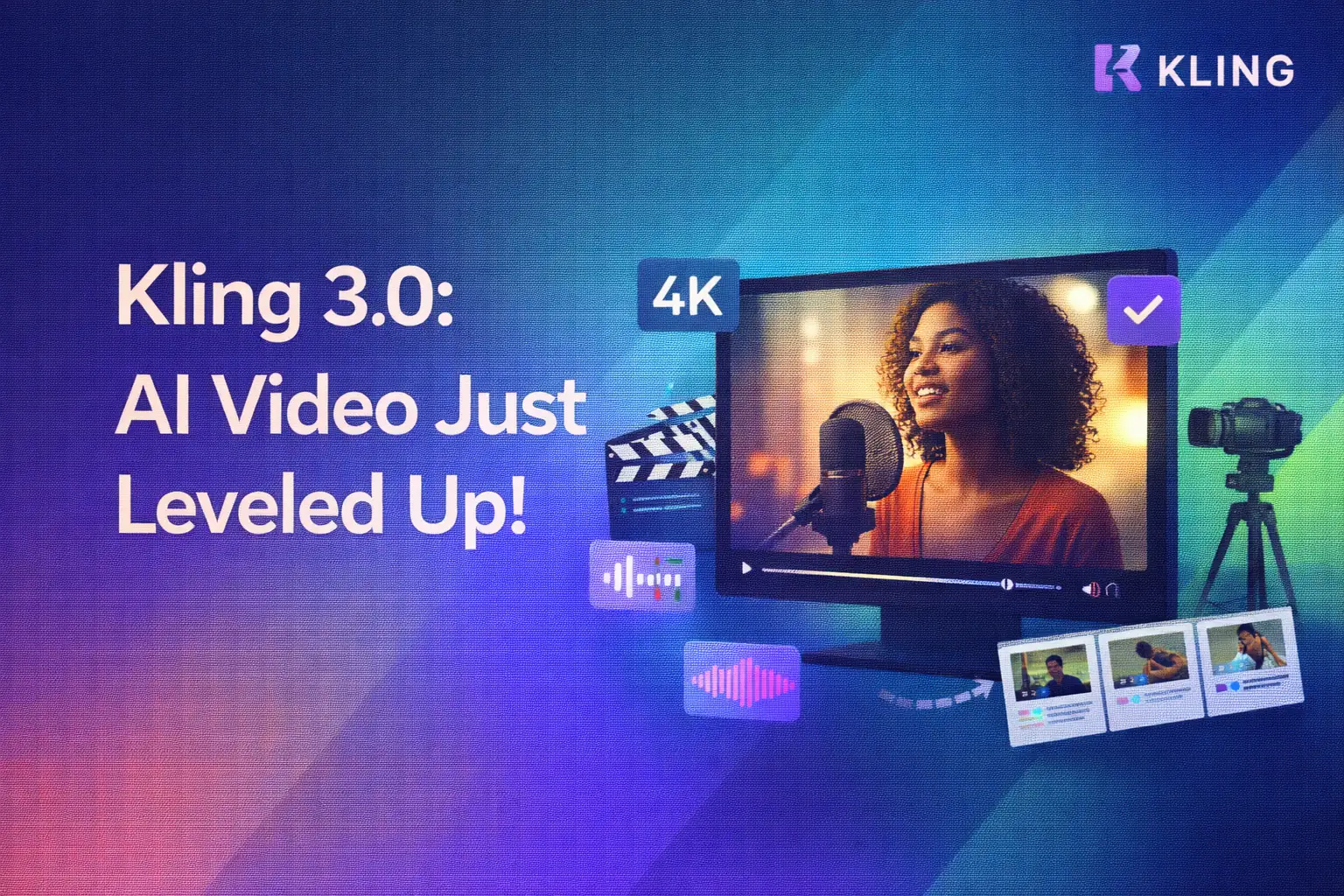
Kling 3.0 Explained: Why This AI Video Model Changes the Creative Workflow
- What Kling 3.0 is really about
- Native 4K video and high frame rates
- Native audio, lip-sync, and sound design
- Longer-form storytelling and structure
- Multi-shot and storyboard workflows
- Character and scene consistency
- Real-world use cases
- Why this matters for creators and teams
What Kling 3.0 is really about
Kling 3.0 is developed by Kuaishou and represents a clear step toward AI video as a production tool rather than a novelty.
Instead of optimizing purely for visual wow-factor, this version focuses on:
- Higher technical output quality
- Longer, more coherent video sequences
- Integrated audio and timing
- Workflow control across multiple shots
The result is a model that feels less like a generator of isolated clips and more like a system designed to support storytelling and structured content creation.
Native 4K video and high frame rates
One of the most tangible upgrades in Kling 3.0 is its support for native 4K video output and frame rates up to 60 fps.
In practice, this means:
- Cleaner motion without jitter or interpolation artifacts
- Sharper details suitable for large screens
- Footage that holds up better after compression on social platforms
For marketers and creators, this matters because AI video is often reused across multiple channels. A single 4K master can be cropped for vertical, square, and horizontal formats without falling apart visually.
This is especially relevant for brands that want consistent quality across ads, websites, and presentations without manually upscaling or re-rendering content.
Native audio, lip-sync, and sound design
Kling 3.0 introduces native audio generation and synchronization as part of the core workflow.
Instead of treating audio as an afterthought, the model now supports:
- Basic sound effects aligned to visuals
- Lip-sync that matches speech timing
- More coherent audiovisual pacing
This significantly reduces post-production work. In earlier AI video pipelines, creators often had to export silent video and rebuild timing manually in editing software. Kling 3.0 closes much of that gap.
For short-form content, this can easily cut production time in half. For longer videos, it means fewer manual alignment errors and more consistent results.
Longer-form storytelling and structure
A major limitation of earlier AI video models was duration. Clips looked impressive, but anything longer than a few seconds quickly fell apart.
Kling 3.0 explicitly targets extended storytelling. Longer sequences are more stable, and the model maintains narrative coherence over time.
This enables use cases such as:
- Short narrative films
- Brand stories with a clear beginning, middle, and end
- Educational explainers that build ideas progressively
Instead of stitching together unrelated fragments, creators can now think in scenes and sequences.
Multi-shot and storyboard workflows
One of the most important but less flashy upgrades is Kling 3.0’s support for multi-shot and storyboard-style workflows.
This allows creators to:
- Define scenes ahead of time
- Control transitions between shots
- Maintain visual logic across cuts
For filmmakers and agencies, this feels familiar. It mirrors how real productions are planned, rather than forcing everything into a single prompt.
The practical benefit is predictability. Instead of hoping a long prompt produces something usable, teams can guide the output step by step.
Character and scene consistency
Consistency has been one of the hardest problems in AI video generation.
Kling 3.0 makes noticeable improvements in:
- Keeping characters visually stable across shots
- Maintaining environments and lighting
- Handling multiple camera angles without breaking identity
This is crucial for branded content, recurring characters, or serialized storytelling. Viewers quickly notice when faces or environments subtly change, and earlier AI models struggled badly here.
While not perfect, Kling 3.0 reduces these issues enough to make multi-shot narratives realistic.
Real-world use cases
Social media and short-form content
- High-quality vertical videos that don’t look “AI-generated”
- Consistent characters across multiple posts
- Faster production cycles without external editors
Marketing and advertising
- Rapid A/B testing of video concepts
- Localized versions of the same campaign
- Product visuals with synchronized audio cues
Storytelling and short films
- Proof-of-concept narratives
- Visual storyboards brought to life
- Low-budget experimentation without crews
Education and explainers
- Step-by-step visual explanations
- Consistent scenes across lessons
- Audio and visuals aligned automatically
Why this matters for creators and teams
Kling 3.0 signals a broader shift in AI video: from novelty to infrastructure.
For teams, this means:
- Lower production costs
- Shorter feedback loops
- More control without specialist tooling
It won’t replace traditional filmmaking, but it does change who can experiment, how fast ideas can be tested, and how scalable video creation becomes.
Kling 3.0 doesn’t just raise the bar technically. It reshapes expectations of what AI video can realistically be used for today.
Curious what AI can build for your business?
I build AI-powered apps, automations and content pipelines - like the Hola Calle language app.
Get in touch