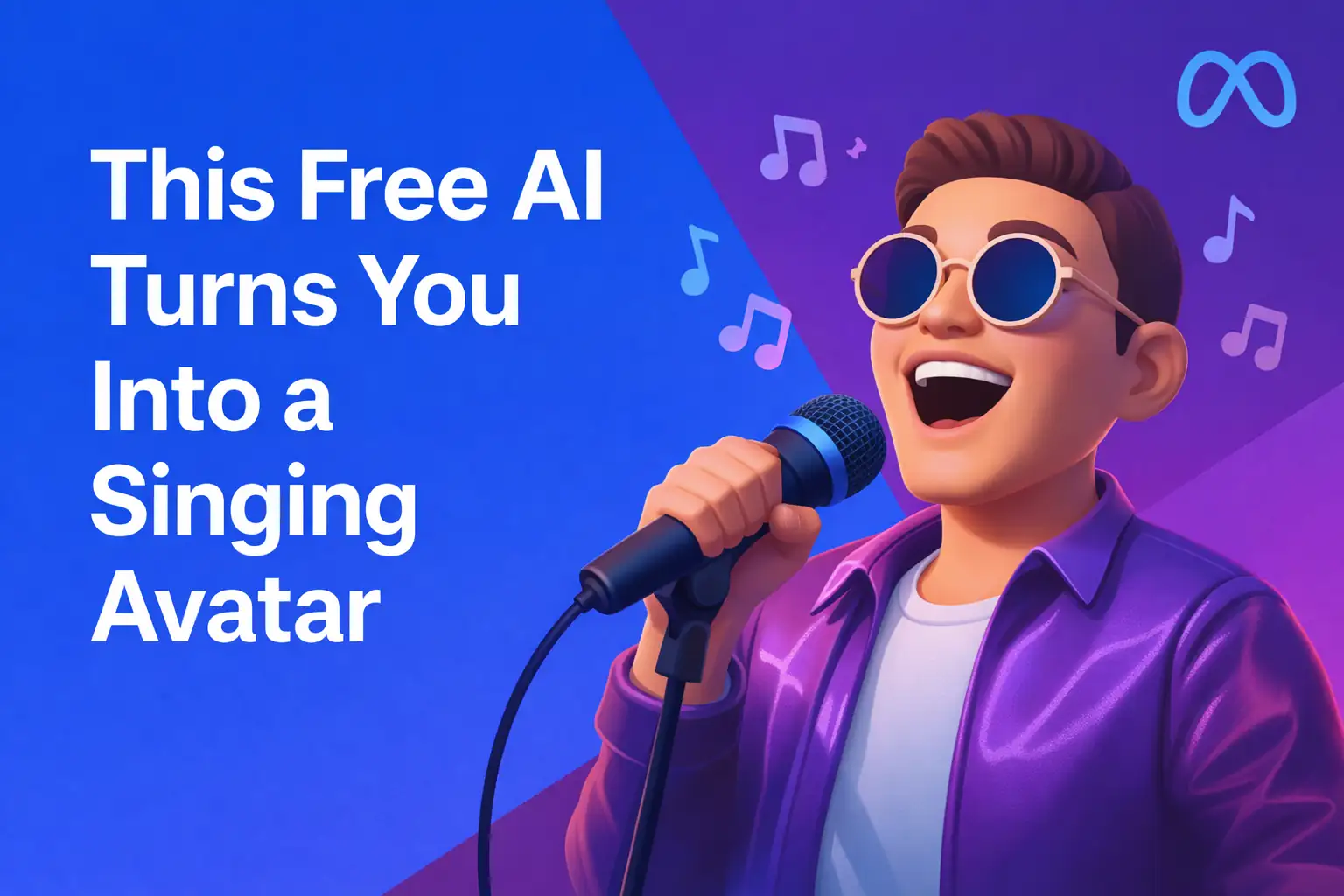
Meta’s New Free AI Avatar Tool Is Changing How Content Gets Created
- What Meta’s new AI avatar tool actually is
- What the tool can do today
- How the creation flow works
- Real-world use cases and examples
- Why this matters for creators and businesses
- What this says about the future of content
What Meta’s new AI avatar tool actually is
Meta’s latest AI feature lives inside the Meta AI app and focuses on expressive, animated avatars. Instead of generating static images or generic videos, the system allows you to create AI versions of yourself that can sing, lip sync, perform and interact with others.
The tool combines several capabilities that previously lived in separate products: image generation, avatar creation, voice synthesis, music alignment and facial animation. By merging these into one flow, Meta lowers the barrier for creative expression dramatically.
What stands out is that this is not positioned as a professional production suite. It is designed to feel fast, social and collaborative, which makes it ideal for short-form platforms and experimentation.
What the tool can do today
At its current stage, the tool already offers a surprisingly broad feature set.
- AI avatars of yourself You can generate multiple versions of yourself in different styles, outfits, moods or fictional personas. These avatars are expressive and designed to work well with music and motion.
- Singing and lip syncing The avatars can perform songs with accurate lip movements that match rhythm and phrasing. This removes the need for recording vocals or syncing audio manually.
- Music integration You can select tracks from Meta’s AI music library or combine them with text-based prompts to shape the vibe of the performance.
- Collaborative scenes Friends can add their own AI avatars to the same scene, making it easy to create group content without meeting in person.
- Natural-language editing Instead of sliders or timelines, you adjust everything by describing changes in text, such as mood, style or character behavior.
How the creation flow works
The workflow is intentionally simple.
- Download the Meta AI app.
- Tap the plus button to start a new creation.
- Describe the image or character you want in text.
- Edit and refine the result using natural language instructions.
- Add yourself or friends to the scene.
- Select lip sync and choose music.
- Add text or your own voice if desired.
Within minutes, you have a short video that would normally require filming, editing and post-production. The friction is almost completely removed.
Real-world use cases and examples
The most interesting part is how people can use this in practice.
Personal creators
A creator can generate a daily music-based post featuring an AI version of themselves reacting to trends or songs.
No camera setup, no lighting, no reshoots.
This makes consistency far easier.
Friends creating together
A group of friends can create a collaborative video where each person appears as an AI avatar, even if they are in different countries.
The result feels social, playful and highly shareable.
Personal branding
Someone building a personal brand can experiment with different visual identities without committing to one look.
The same person can appear as a professional presenter one day and a stylized character the next.
Marketing experiments
Small brands can test creative video concepts without hiring actors or agencies.
A campaign idea can be visualized in hours instead of weeks.
Internal team content
Teams can create internal announcement videos, onboarding content or morale boosters using AI avatars, removing the pressure of being on camera.
Why this matters for creators and businesses
On the surface, this looks like entertainment. But strategically, it shows where content creation is heading.
- Lower production costs Video becomes accessible without studios, equipment or editing expertise.
- Higher creative output When the cost of experimentation drops, creativity increases.
- Faster iteration Ideas can be tested quickly, refined and discarded without sunk costs.
- Personalization at scale One person can appear in many formats, styles and languages without extra effort.
For marketers, this blends personal branding with AI in a way that feels native to social platforms. For teams, it opens new ways of collaborating asynchronously. For individuals, it removes the fear of being on camera.
What this says about the future of content
This tool is less about singing avatars and more about a shift in storytelling. AI is moving from assisting creators to becoming a creative layer itself.
Content is no longer limited by who is available, how confident they feel on camera or how much time they have. Instead, ideas become the main bottleneck.
That raises new questions about authenticity, identity and creative ownership. But it also unlocks an entirely new creative space where expression is faster, more playful and more inclusive.
Whether you see this as exciting or unsettling, one thing is clear. AI-powered storytelling is entering a new phase, and Meta is positioning itself right at the center of it.
Curious what AI can build for your business?
I build AI-powered apps, automations and content pipelines - like the Hola Calle language app.
Get in touch