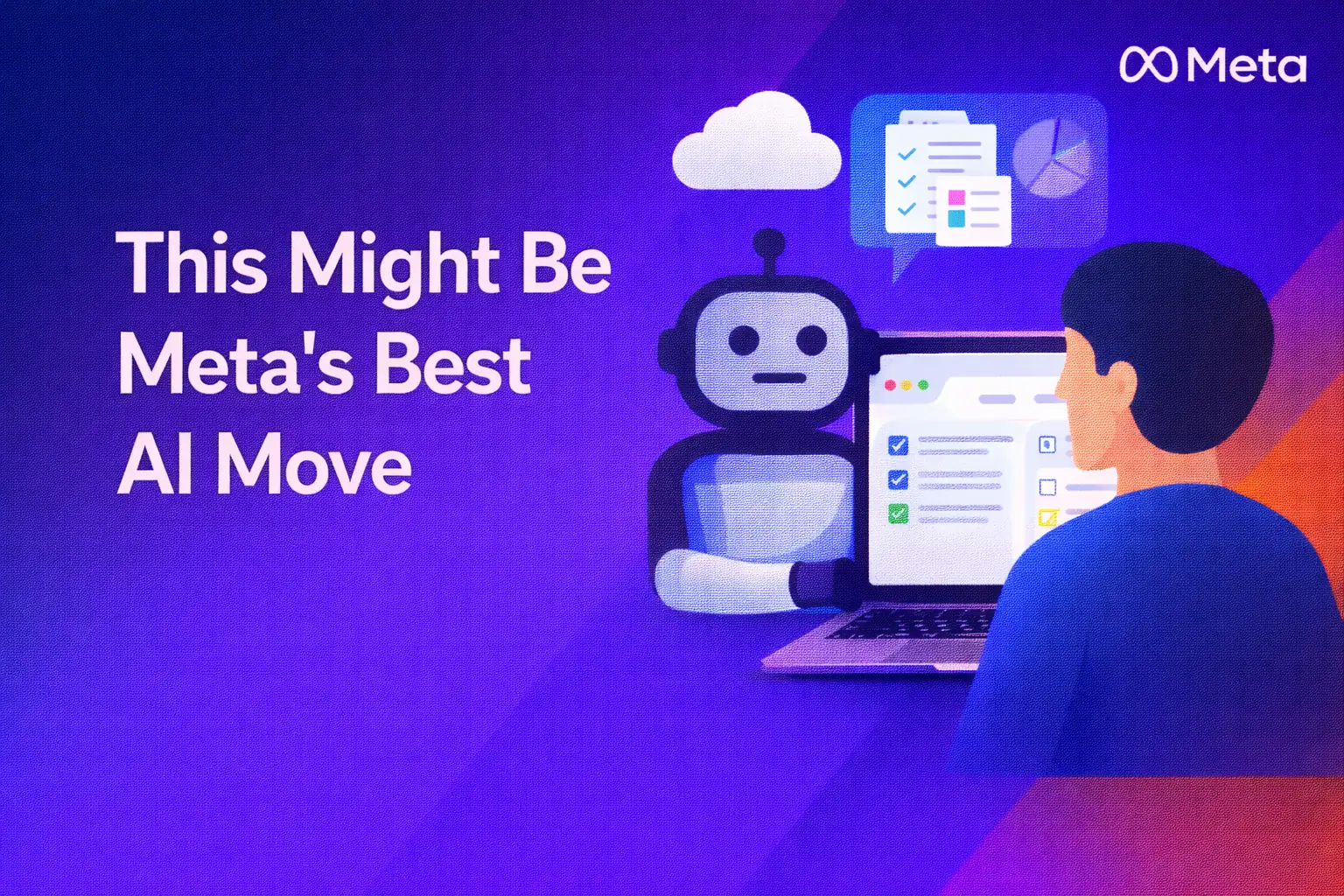
Why Meta’s Manus Feels Like a Real AI Co-Worker, Not a Chatbot
- What Manus actually is (and what it is not)
- Why Manus feels different from typical AI tools
- Strong context across tasks and time
- Real-world workflow examples
- Business value and productivity impact
- Why this acquisition matters for Meta
- From AI models to long-term AI collaboration
What Manus actually is (and what it is not)
Manus is often described as an AI assistant, but that label does not really do it justice.
It is not a conversational interface where you repeatedly explain what you want. It is not a prompt playground. And it is not designed for casual experimentation.
Manus is built as a cloud-based AI co-worker. Something that understands ongoing work, remembers context across sessions, and behaves in a predictable way.
That difference changes how you interact with it. You do not “ask” Manus to do things in the same way you ask a chatbot. You collaborate with it.
Why Manus feels different from typical AI tools
The first thing that stands out is how little prompt-engineering is required.
With many AI tools, you spend a significant amount of time explaining structure, tone, constraints, and expectations over and over again. Manus largely removes that friction.
Once it understands how you work, the interaction becomes simpler and more natural.
- Less rephrasing and repetition
- Fewer “corrective” prompts
- More stable and predictable output
- A stronger sense of continuity
This makes it feel less like issuing commands and more like working alongside a colleague who already knows the context.
Strong context across tasks and time
One of Manus’ strongest qualities is its ability to maintain context across multiple tasks and sessions.
Instead of treating every request as a standalone interaction, it understands how tasks relate to each other.
For example, if you are working on a long-running project, Manus can:
- Remember decisions made earlier in the process
- Apply consistent structure and terminology
- Adapt output based on previous feedback
- Continue work without needing a full reset
This is where Manus starts to feel “adult”. It does not constantly forget what you are doing.
Real-world workflow examples
Content and research workflows
Imagine working on a multi-week research project. Manus can track themes, summarize findings, and help refine drafts over time without needing repeated explanations.
Instead of starting from scratch each day, you continue where you left off.
Product and strategy work
For product teams, Manus can assist with planning documents, requirement breakdowns, and internal communication. It maintains consistency in language and structure across multiple artifacts.
Operational tasks
Recurring tasks such as reporting, documentation updates, or process reviews become easier when the AI understands both the task and the surrounding workflow.
Cross-functional collaboration
Because Manus is built for shared environments, it works well in teams where multiple people interact with the same AI context.
Business value and productivity impact
Manus is not cheap. And that is intentional.
This is not a tool designed for casual use or quick experiments. It is aimed at people and teams who want to buy back time.
The real value comes from:
- Reduced cognitive load
- Less repetition and rework
- Faster execution on complex tasks
- More consistent output across time
For businesses, this translates into productivity gains that compound rather than reset every session.
Why this acquisition matters for Meta
Meta did not need another model. It already has strong research and infrastructure.
What it lacked was a practical layer that makes AI usable in everyday work.
Manus fills that gap.
It acts as the bridge between raw AI capability and actual productivity. Between models and meaningful collaboration.
If Meta integrates Manus deeply into its ecosystem, it could become the foundation for how AI is used across work, communication, and operations.
From AI models to long-term AI collaboration
The most important shift here is conceptual.
We are moving from AI as a tool you occasionally consult to AI as a long-term collaborator.
Manus represents that shift clearly. It is not flashy. It is not hype-driven. It is designed to work reliably, day after day.
If this direction continues, the winners will not be the companies with the loudest launches, but those that build AI systems people can actually work with for years.
No hype. Just a foundation.
Curious what AI can build for your business?
I build AI-powered apps, automations and content pipelines - like the Hola Calle language app.
Get in touch